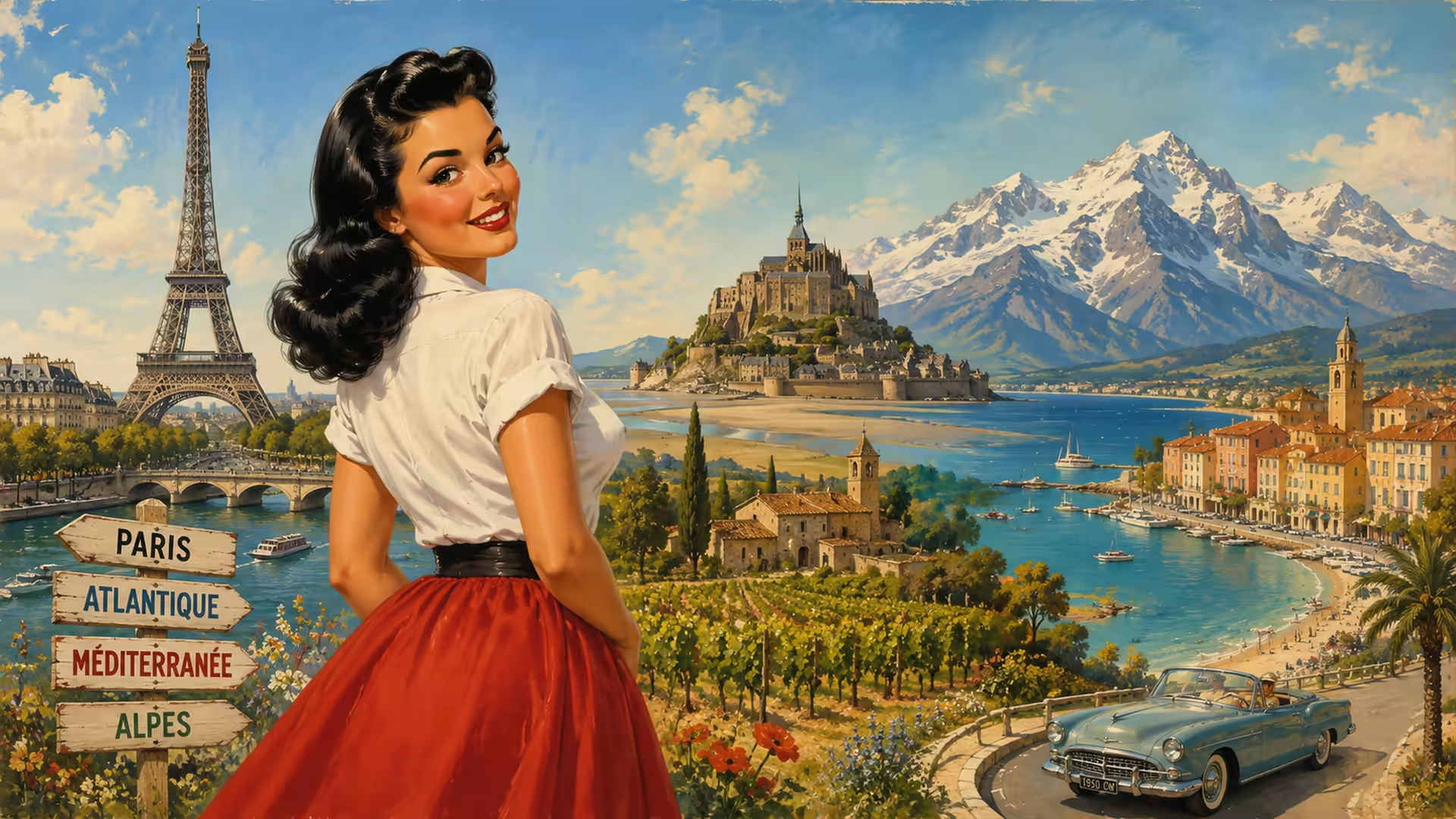
Eleven stops, eleven stories and just as many memories. From the stones of Carnac to the snows of Mont Blanc, Caroline travels across France and tells the stories that make each place unique.
Her France notebook
One country, a thousand stories
Caroline does not travel across France by ticking places off a map. Every stop gives her a reason to linger: a monument turned symbol, a landscape shaped by the wind, a wine tradition passed down for centuries, a harbour facing the open sea or stones raised long before writing existed.
This page brings together her first destinations in France. Each illustration comes with a short historical overview to understand the place, followed by a link to its future full story. And because Caroline always brings something home from her travels, every stop also has a collectible poster.
11stops in France
1 storybehind every illustration
€29.90poster price
01
Paris · Île-de-France
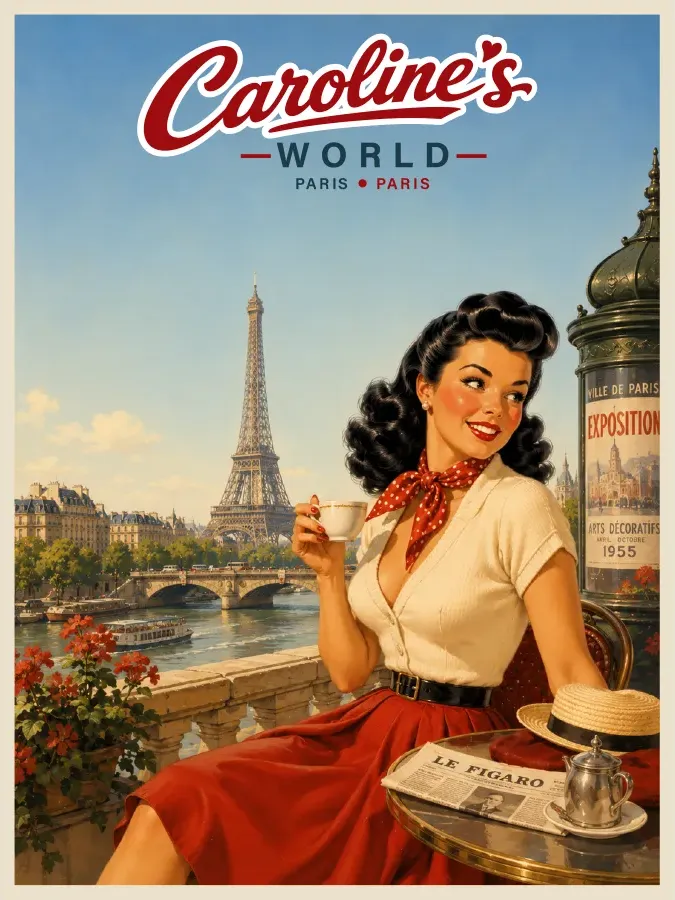
Paris — The Eiffel Tower
Built for the 1889 Exposition Universelle, held to mark the centenary of the French Revolution, the Eiffel Tower was constructed between January 1887 and March 1889. Developed from the project of Gustave Eiffel and his engineers Maurice Koechlin and Émile Nouguier, with architect Stephen Sauvestre, it was completed in just two years, two months and five days. Initially opposed by part of the artistic community, this 300-metre iron structure has become one of the most recognisable symbols of Paris and France.
Did you know?The iron structure was assembled from more than 18,000 parts and around 2.5 million rivets.
At the entrance to Arcachon Bay, the Dune du Pilat is a living landscape formed through several phases of sand accumulation over the past four millennia. Its successive layers, separated by ancient vegetated soils known as palaeosols, preserve evidence of climate change and human occupation. The present dune began moving again in the 19th century under the combined effects of wind, sand and coastal erosion. Today it remains the tallest dune in Europe and continues to advance towards the forest.
Did you know?The dune contains around 55 million m³ of sand and can advance several metres eastwards in some years.
The history of the Promenade des Anglais is closely tied to British winter visitors who came to enjoy Nice's mild climate in the 19th century. In 1824, Reverend Lewis Way encouraged the creation of a coastal path funded by this community. The 'Camin dei Inglès' was later widened and officially named the Promenade des Anglais. Lined with villas, hotels and grand palaces, it became the heart of the winter resort's social life before accompanying the rise of seaside and summer tourism in the 20th century.
Did you know?Today the promenade follows the Baie des Anges for nearly seven kilometres.
In Burgundy, the grape harvest is the culmination of a winegrowing history shaped by centuries of work and close observation of the terroir. Since the early Middle Ages, particularly under the influence of the Benedictine and Cistercian orders and later the Dukes of Burgundy, winegrowers gradually identified and delimited plots with distinctive characteristics: the famous 'Climats'. This model closely ties each wine to its place of origin. The landscapes of the Côte de Nuits and Côte de Beaune still reflect this meticulous organisation, now recognised as a UNESCO World Heritage Site.
Did you know?In Burgundy, a 'Climat' is not the weather: it is a precisely delimited vineyard plot with a historically recognised identity.
Before becoming an international seaside resort, Biarritz was a maritime village and a port closely linked to fishing. Its transformation accelerated in the 19th century. Victor Hugo stayed here in 1843 and already sensed its future success. A few years later, Napoleon III had Villa Eugénie built for his wife, Empress Eugénie. The imperial couple stayed regularly from 1854 to 1868, drawing royalty and European aristocracy in their wake. In the 20th century, Biarritz developed a new identity around the ocean and also became one of Europe's leading surf destinations.
Did you know?The former Villa Eugénie became the Hôtel du Palais, one of the great symbols of Biarritz's imperial history.
The Carnac alignments are among the most impressive megalithic complexes in the world. Erected during the Neolithic period around 6,500 years ago, they bear witness to settled communities developing agriculture, livestock farming and monumental architecture. Nearly 3,000 standing stones extend over several kilometres. Their organisation, exact purpose and the reasons these communities raised so many stones continue to fuel archaeological research. In 2025, the Carnac megalithic site joined the UNESCO World Heritage List.
Did you know?The alignments stretch for nearly four kilometres: a true architecture of the prehistoric landscape.
At the mouth of the Seine, Honfleur was long a strategic port serving fishing, maritime trade and major expeditions. In the 17th century, Colbert sent Duquesne to study the port's modernisation. Between 1684 and 1690, the old tidal harbour was transformed into a floating basin through the construction of locks and quays: the origin of today's Vieux Bassin. Its tall narrow-fronted houses, harbour and distinctive light later attracted many artists, particularly in the 19th century.
Did you know?Honfleur once fitted out ships bound for Newfoundland, Canada, the East Indies and the Guinea coast.
Dominating the mountain range that bears its name, Mont Blanc became one of the great symbols of Alpine exploration in the 18th century. On 8 August 1786, Jacques Balmat and Dr Michel-Gabriel Paccard reached the summit, completing the first recognised ascent. Their achievement marked a founding moment in the history of mountaineering. In summer, the massif reveals glaciers, jagged peaks, valleys and trails that shaped the identity of Chamonix and drew travellers, scientists and later mountaineers from across Europe.
Did you know?The first ascent of Mont Blanc in 1786 is often regarded as one of the founding events of modern mountaineering.
Winter transforms the Mont Blanc massif into a spectacular world of snow, ice and high mountains. Chamonix first became known through travellers drawn to its glaciers and then the earliest mountaineers; by the 19th and 20th centuries the valley had also become a major centre for winter sports. The history of the massif remains inseparable from the rise of mountaineering, mountain guides and an Alpine culture combining exploration, tourism and adaptation to an exceptionally demanding environment.
Did you know?In 1924, Chamonix hosted the first Winter Olympic Games, then known as the 'International Winter Sports Week'.
Standing on a rocky islet in the heart of a bay shaped by powerful tides, Mont-Saint-Michel combines natural, religious and military heritage. A sanctuary dedicated to the Archangel Michael has existed on the rock since the early 8th century, and a Benedictine abbey was founded there in 966. The monumental complex then developed from the 11th to the 16th century, forcing builders to continually adapt the architecture to an exceptionally challenging site. The Mont and its bay have been on the UNESCO World Heritage List since 1979.
Did you know?Construction of the abbey extended over several centuries: the architecture of the Mont is literally stacked upon the rock.
Toulouse has an urban history stretching back to antiquity, but its present appearance owes much to the terracotta brick that earned it the nickname 'Pink City'. In the Middle Ages, the city developed strong municipal autonomy around its capitouls. From the late 12th century, they acquired buildings to establish the town hall on the site of today's Capitole. Toulouse is also shaped by the Basilica of Saint-Sernin, a major Romanesque monument, and by the golden age of the woad trade, which enriched many merchants during the Renaissance.
Did you know?In Toulouse, brick is more than decoration: it shapes much of the city's architectural identity.
Six short questions to see Caroline's stops in France from a different angle.
Why did the Eiffel Tower become the symbol of Paris?
Built for the 1889 Exposition Universelle, the Eiffel Tower was initially intended to demonstrate French engineering expertise. Its silhouette, scale and visibility across the Paris skyline gradually transformed it into an international emblem of the capital.
The Dune du Pilat is a moving dune. Prevailing winds gradually push the sand inland while tides and erosion reshape the coastline. The landscape is therefore never completely fixed.
Toulouse owes this nickname to the widespread use of terracotta brick in its architecture. Depending on the light, façades can take on pink, orange or red tones, giving the city a very distinctive visual identity.
In Burgundy, a Climat is not a weather term. It refers to a precisely delimited vineyard plot recognised for its own characteristics: exposure, soil, history and winegrowing know-how.
Why is Mont Blanc linked to the history of mountaineering?
The first recognised ascent of Mont Blanc in 1786 marked a major turning point in high-mountain exploration and helped establish Chamonix as a historic centre of European mountaineering.
Why does Mont-Saint-Michel change so dramatically with the tides?
Mont-Saint-Michel stands in the heart of a bay famous for its exceptional tidal range. Depending on the conditions, the water can completely transform the landscape and restore the Mont's island character, strengthening the impression of a monument poised between land and sea.